

A bad quarter at a bank rarely announces itself. A branch adviser skips a suitability question. A call-center agent talks a worried customer into the wrong product. An onboarding flow quietly turns away the people it was built to serve. None of it shows up in the dashboard, because dashboards measure what already happened. By the time it surfaces as a complaint, a mis-selling review or a regulator’s letter, the cost is already booked. Bank mystery shopping is how leading banks catch these moments before they show up in churn and complaints.
Mystery shopping in banking exists to catch those failures while they are still cheap to fix. It is the one method that measures what your staff actually do in front of a customer, against the standard you are supposed to meet, before the problem becomes a fine or a lost relationship. This guide covers what bank mystery shopping is, what it should measure across every channel, ready-to-use scenarios and a checklist, the rules for running it properly, and how to tell whether your program is protecting the business or just generating reports.
It is written from two decades of running mystery shopping and CX programs for financial-services clients across 60 countries, for the people accountable for compliance, service and retention.
What is mystery shopping in banking?
Mystery shopping in banking is the use of trained evaluators who pose as ordinary customers to measure, against a defined standard, how a bank actually delivers service, advice and compliance across its branches, call centers and digital channels. A satisfaction survey captures how customers felt; mystery shopping captures what really happened in the interaction: whether the adviser asked the required questions, whether the product was suitable, whether the disclosure was made, and whether the experience matched the brand promise.
That distinction matters most in banking, because the highest-risk failures are the ones customers do not notice. A customer can leave a branch perfectly satisfied and still have been sold an unsuitable product or skipped through a compliance step. A survey scores that visit five stars. A mystery shop catches the breach.
Why banking needs mystery shopping more than most industries
Plenty of sectors use mystery shopping. Banking depends on it, for reasons specific to how the business and its regulation work.
Compliance failures are expensive and invisible. Banks operate under heavy regulation: anti-money-laundering and know-your-customer checks, suitability and mis-selling rules, fair-treatment and vulnerable-customer obligations, and disclosure requirements. Most of these play out in a conversation, not a system log. Mystery shopping is the only way to observe, consistently and at scale, whether frontline staff actually follow the rules when no one appears to be watching.
Trust is the product. People hand banks their money and their financial futures. One poor interaction at the wrong moment, such as a dismissive response to a struggling customer, a pushy sale or a confusing answer, does lasting damage to a relationship that took years to build. Measuring the quality of those moments protects the asset the whole business runs on.
The sales-versus-service tension is real. Frontline banking staff are often asked to hit sales targets and serve customers well at the same time. Mystery shopping is how a bank checks that incentives are producing helpful advice, not pressure selling that creates conduct risk later.
The experience is now omnichannel. A customer researches online, opens an account in an app, calls with a question and visits a branch to sort out a problem. Weakness in any one channel loses the customer. A program that only shops the branch is measuring a shrinking slice of the real experience.
Demand for this kind of structured measurement is growing. The mystery shopping market is projected to grow from roughly $2.3 billion to $3.6 billion over the coming decade (~5.1% CAGR), and banking and financial services is one of its largest and most compliance-driven segments. (Sources: Fortune Business Insights)
What bank mystery shopping should measure
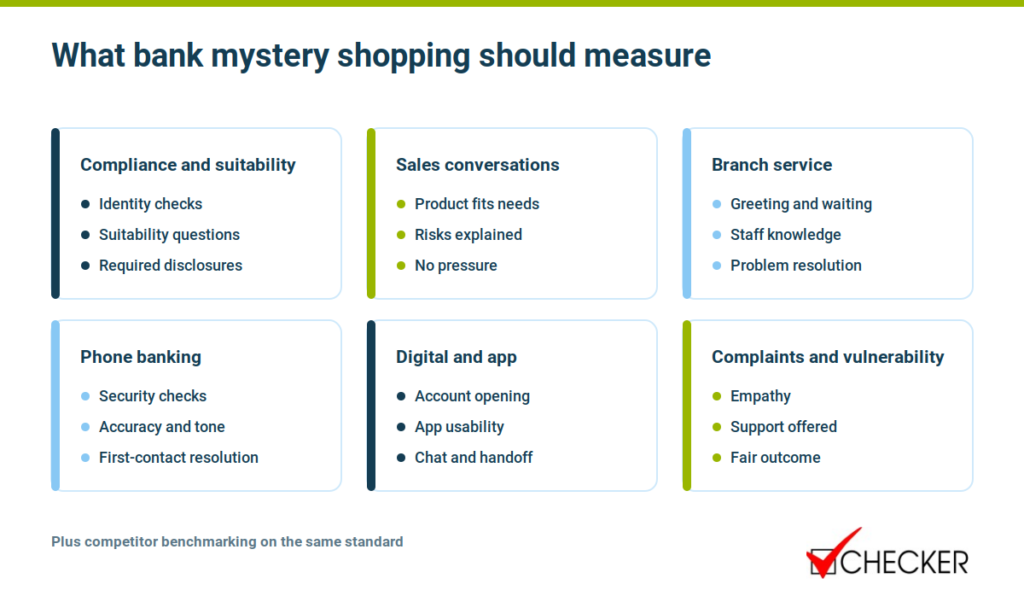
A program that only checks whether the teller smiled is wasting the method. In financial services, the valuable measurement covers several distinct areas.
- Compliance and suitability: Did staff complete required identity and eligibility checks, ask the questions that establish suitability, and make the disclosures they are obliged to make? This is the highest-value use of bank mystery shopping, because it surfaces conduct risk before a regulator does.
- Sales conversations: Was the recommended product genuinely appropriate, or driven by a target? Were risks explained as clearly as benefits? This is where mis-selling exposure is created or avoided.
- Branch service quality: Greeting, waiting time, staff knowledge, problem resolution, and whether the visit matched the brand standard.
- Call center and phone banking: Accuracy, security verification, tone and first-contact resolution, measured with the same rigor as the branch.
- Digital and mobile experience: Account opening, app usability and online support, where a growing share of customers now form their opinion and where friction quietly kills conversion.
- Complaint and vulnerable-customer handling: How staff respond when a customer is upset, confused or in financial difficulty. This is both a conduct obligation and a loyalty moment.
- Competitor benchmarking: The same standard applied to rival banks, so “we’re doing fine” becomes “we’re behind the bank across the street on onboarding speed and adviser knowledge.”
The pattern that works: mystery shopping to measure delivered quality and compliance objectively, customer surveys to measure sentiment at scale, and competitor benchmarking to put both in context.
What a compliance-grade program looks like in practice
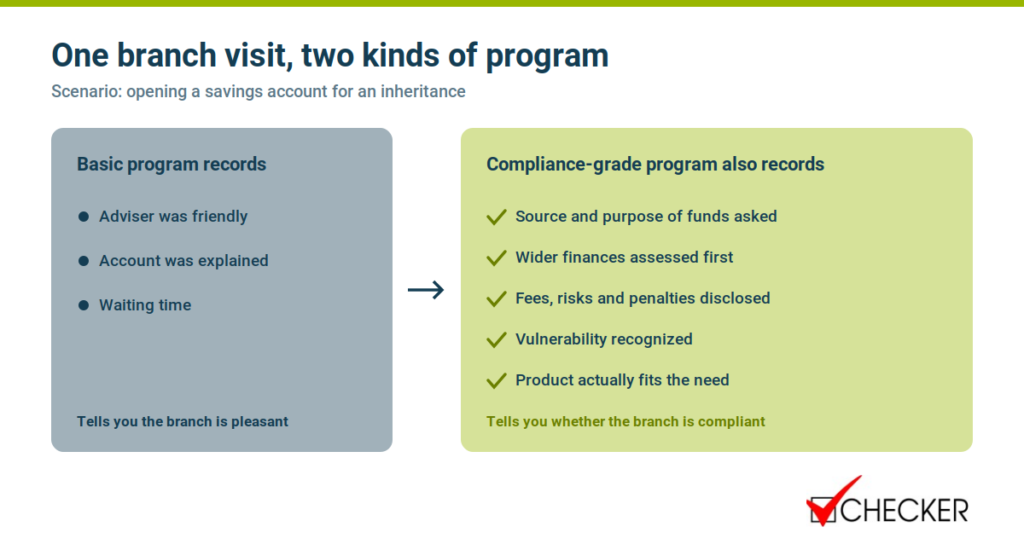
Consider a common scenario. An evaluator visits a branch to ask about opening a savings account and moving a modest inheritance. A weak program records that the adviser was friendly and explained the account. A compliance-grade program records much more: whether the adviser asked about the source and purpose of the funds, assessed the customer’s wider financial situation before recommending anything, disclosed fees and risks in plain language, recognized that a recent bereavement can signal a customer under emotional strain, and whether the product recommended actually fit the customer’s needs.
That is the difference between a nice-to-have and a risk control. The first tells you the branch is pleasant. The second tells you whether the branch is compliant, and gives you specific, coachable evidence to fix it if it is not.
The same visit, scored
Here is how that visit might be scored in a compliance-grade program for a fictional retail bank.
The brief. The evaluator is 52, recently inherited a modest sum after a parent’s death, has no investment experience and wants to keep the money safe but earn something on it. She mentions the bereavement early in the conversation, and says she may need part of the money within a year.
| Section | What happened | Score |
|---|---|---|
| Welcome and waiting | Greeted promptly; 8-minute wait for an adviser, with an apology | 8 / 10 |
| Needs discovery | Asked about goals and time horizon; did not ask about other savings, debts or income | 10 / 20 |
| Source and purpose of funds | Asked where the money came from and what it was for; explained why the bank needs to know | 10 / 10 |
| Suitability of recommendation | Recommended a two-year fixed-term deposit, despite the customer saying she might need the money within a year | 5 / 20 |
| Disclosure | Interest rate and deposit protection explained clearly; early withdrawal penalty not mentioned | 8 / 15 |
| Vulnerability | Acknowledged the bereavement with empathy, offered to arrange a follow-up instead of deciding today | 15 / 15 |
| Closing | Summary given; product leaflet handed over; no written record of the needs discussed | 6 / 10 |
| Total | 62 / 100 |
A survey of this customer would probably score the visit highly: the adviser was warm and patient. Yet the visit contains a real conduct risk, an unsuitable product with an undisclosed penalty, alongside genuinely good vulnerable-customer handling. That combination of risk to fix and behavior to reinforce is exactly what a coaching conversation needs.
A scenario library for bank mystery shopping
The value of a bank program depends on the scenarios it tests. These cover the interactions that carry the most risk and the most loyalty, across channels.
| Scenario | Channel | What it tests |
|---|---|---|
| Opening a current or savings account | Branch, app, web | Identity checks, clarity of fees and terms, onboarding friction |
| First-time mortgage enquiry | Branch, phone | Affordability questions, clarity of rates, fees and risks, follow-up |
| Investment or pension advice | Branch, adviser appointment | Risk profiling, suitability, cost and risk disclosure, no pressure |
| Loan or credit card application | App, web, branch | Affordability checks, representative APR and total cost explained, responsible lending |
| Customer in financial difficulty | Phone, branch | Empathy, signposting to support, forbearance options, no pressure to borrow more |
| Bereavement or power of attorney | Branch, phone | Sensitivity, clear process, accurate document requirements |
| Complaint about a fee or error | Phone, chat, branch | Acknowledgement, ownership, resolution, information about escalation rights |
| Large or unusual transfer request | Branch, phone | Fraud and scam awareness, questions about the payee, warnings given |
| Account closure or switching away | Branch, phone, app | Fair process, accurate information, retention without obstruction |
| Query to the chatbot and handoff to a person | App, web chat | Accuracy of automated answers, ease of reaching a human, context carried over |
The large-transfer scenario deserves special mention. Authorized push payment scams, where customers are tricked into sending money to fraudsters, are a major concern for banks and regulators. Mystery shopping is one of the few ways to test whether staff actually spot warning signs and intervene before the money leaves.
Sample checklist: a branch advice visit
Adapt this to your own service standards and the regulatory requirements of each product and market.
Arrival and welcome
- Acknowledged within [X] seconds of entering
- Waiting time to see an adviser under [X] minutes, or a clear estimate given
- Branch clean, tidy, with up-to-date product information and required notices displayed
Needs discovery
- Adviser introduced themselves and explained what the meeting would cover
- Asked about the customer’s goals and time horizon
- Asked about wider financial situation: income, savings, debts, existing products
- Asked about attitude to risk and experience with financial products, where relevant
Compliance
- Identity and eligibility checks explained and carried out as required
- Source and purpose of funds asked where required
- Required disclosures made: fees, charges, rates, risks, penalties, deposit protection
- Customer not pressured to decide on the day
Recommendation
- Recommendation matched the needs the customer described
- Benefits and risks explained in plain language
- Alternatives mentioned where appropriate
Vulnerability and care
- Signs of vulnerability (bereavement, illness, financial difficulty, confusion) recognized and responded to
- Customer offered extra time, a follow-up or support as appropriate
Closing
- Summary of what was discussed and agreed
- Written information provided
- Clear next step and contact details given
- Follow-up contact made within the promised time, if agreed
The rules for shopping a bank properly
Mystery shopping a regulated business needs extra care, because evaluators interact with processes designed to prevent fraud and protect customers.
- Never use false identity documents. Evaluators must not provide fake documents, false personal data or invented financial information that would be relied on in a real application. Scenarios should be designed so that this is never needed.
- Stop before a binding contract. Most bank scenarios end before an account is opened, a loan is signed or a product is bought. Where a real transaction is part of the scenario, the evaluator uses their own genuine identity, and the bank should know in advance how such accounts will be handled and closed.
- Follow regulator guidance. Some financial regulators have published guidance on how firms should use mystery shopping, and some run mystery shopping programs of their own. Check what applies in each market before designing scenarios.
- Protect personal data. Reports, call recordings and notes contain information about employees, and sometimes about the evaluator’s own finances. They need a lawful basis, limited retention and secure storage under rules such as the GDPR.
- Record calls only where lawful. Call recording laws vary between countries; check before recording, and inform the client of the approach.
- Tell staff the program exists. Employees should know mystery shopping is part of quality and compliance monitoring, even if they do not know when it happens.
- Use findings fairly. Results should drive coaching, training and process improvement. Using a single shop to discipline an individual undermines trust in the whole program.
This section is general information, not legal advice; the rules that apply depend on the country and the products involved.
How a compliance-grade bank program runs
In a regulated environment, a mystery shopping program has to do more than produce scores: its findings must stand up if compliance, audit or a regulator asks how they were reached. That shapes every stage.
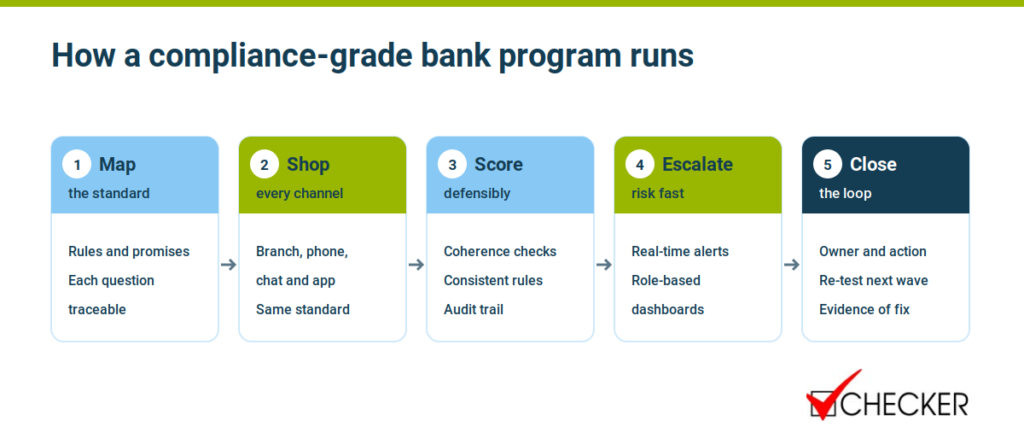
1. Map the standard to the obligation. Start from the interactions that carry regulatory and conduct requirements, such as advice, lending, onboarding, complaints and vulnerable customers, and write questions that test each obligation directly. Pair them with your service standards. Every question should be traceable to either a rule or a brand promise; anything that is neither probably does not belong.
2. Shop every channel the customer uses. Branch visits, phone banking, chat and app journeys should all be tested against the same standard, in every region and language you operate in. Comparable results across channels are what reveal whether a problem is local or systemic.
3. Make scoring defensible. Long questionnaires with weighted compliance questions need rigorous, consistent quality control: coherence checks between answers and comments, consistent application of penalty and bonus rules, and a clear audit trail of every edit. Automation helps here not only by saving time, but by applying the same rules every time, which manual review cannot guarantee.
4. Escalate risk fast. A failed compliance question should not wait for the monthly report. Real-time alerts to compliance teams, and role-based dashboards for branch, regional and head-office managers, let the bank act on conduct risk while it is still a single visit, not a pattern.
5. Close the loop. Each finding gets an owner, a coaching or process action and a re-test in the next wave. Evidence that issues were found, fixed and verified is often as valuable to the compliance function as the scores themselves.
For banks and for agencies
If you’re a bank or financial institution measuring your own branches, call centers and digital channels, the priorities are a single standard applied everywhere, early visibility of conduct risk, and findings your operations and compliance teams can act on within days. The common trap is a branch-only program with lagging reports, which lets risk build unseen between measurement cycles.
If you’re a market research or mystery shopping agency serving financial-services clients, the bar is higher than in most sectors: defensible scoring, a clear audit trail, scenarios that respect regulatory boundaries, and fast, white-labelled reporting, delivered across many clients, channels and countries. Margins disappear quickly when compliance-grade QA is done by hand; the agencies that win banking work automate it.
In-house, platform or agency?
| Approach | Strengths | Watch out for |
|---|---|---|
| In-house, with your own evaluators and spreadsheets | Full control; deep product knowledge | Hidden labor in recruiting, scheduling, QA and reporting; staff may be recognized; manual QA is where compliance scoring becomes inconsistent |
| A dedicated platform | Multi-channel collection, automated and auditable QA, live dashboards and alerts; your team focuses on acting on risk | Requires adopting and configuring a system |
| A specialist agency | Trained evaluators, scenario expertise, capacity across markets | Less direct control; slower results if the agency’s technology is dated |
The right choice depends on how many channels and markets you cover, how often you measure, how much compliance weight the scoring carries, and how quickly findings must reach the people who act on them. Beyond a handful of branches shopped once a year, a manual approach tends to become both the most expensive and the hardest to defend.
Metrics for bank mystery shopping
| Metric | What it tells you |
|---|---|
| Compliance pass rate, by requirement | Share of visits where each required check or disclosure was completed |
| Suitability score | Whether recommendations matched the needs the evaluator described |
| Disclosure completeness | Whether fees, rates, risks and penalties were all explained |
| Vulnerable-customer handling score | How staff recognized and responded to signs of vulnerability |
| Fraud intervention rate | Share of suspicious-transfer scenarios where staff questioned the payment and gave a warning |
| Service score by channel | Branch, phone, chat and app performance on the same standard |
| First-contact resolution | Share of queries resolved without a follow-up contact |
| Follow-up rate | Whether promised callbacks and follow-up appointments actually happened |
| Competitor gap | Your score versus competitor banks on the same scenarios |
| Time to action | Days between a failed compliance item and a documented corrective action |
Report compliance metrics separately from service scores. A branch can be friendly and fast while failing on disclosure; averaging the two into one number hides exactly the risk the program exists to find.
Common mistakes that undermine bank mystery shopping
- Shopping the branch only. Customers now judge you across app, phone and web. A branch-only program measures a shrinking part of the experience.
- Measuring friendliness, not compliance. If the questionnaire scores warmth but not whether required questions were asked, it misses the highest-value risk.
- Blending compliance into one overall score. Report compliance separately, or a good service score will hide a serious breach.
- Reports that arrive too late to act on. A compliance gap found a month later has already run unmanaged for a month. If it is not near-real-time, it is not a control.
- Findings with no coaching loop. Data nobody owns produces no improvement. Every finding needs an owner and a follow-up.
- Inconsistent scoring across evaluators and regions. Without rigorous QA, the same behavior gets scored differently, and the data stops being comparable, which is fatal for a compliance program.
- Scenarios that cross regulatory lines. Using false identities or completing real applications on invented data creates risk for the bank, the agency and the evaluator.
- Treating it as a one-off. A single annual snapshot misses the gaps that open up between cycles.
Where bank mystery shopping is heading
Digital journeys as a core measurement. As more banking moves to app and web, programs are extending from the branch to online account opening, in-app support and chat, where much of today’s experience and drop-off now lives.
Testing AI assistants and chatbots. Banks increasingly use AI to answer customer questions. Mystery shopping can test whether those answers are accurate and compliant, and whether customers can easily reach a person when they need one.
Fraud and scam prevention. With authorized push payment fraud a priority for banks and regulators, more programs include scenarios that test whether staff and digital journeys warn customers and intervene effectively.
A sharper focus on vulnerable customers. Regulators increasingly expect banks to show they treat customers in difficulty fairly, and mystery shopping is one of the few ways to test and evidence how frontline staff actually handle those moments.
AI in quality control. Automated coherence checks on evaluator write-ups and rule-based scoring reduce the manual QA that long compliance questionnaires demand, and make results more consistent across evaluators and markets.
Real-time compliance monitoring. Monthly reports are giving way to alerts and live dashboards that flag a conduct gap the moment it is scored.
Turning oversight into an advantage
Bank mystery shopping is not a secret shopper with a checklist. It is how a bank finds out, before a regulator or a departing customer does, whether the advice, care and compliance it promises are actually delivered at the front line: in every branch, on every call and in every app.
The banks that get the most from it test the conversations that carry real risk, score them consistently enough to defend, and put the findings in front of the people who can act while a problem is still one visit rather than a pattern. Done that way, the same program that protects the bank also shows staff what excellent service looks like, which is how oversight becomes loyalty.
See how Checker runs compliance-grade mystery shopping and CX programs for banks and financial-services firms. Request a demo and bring your own standards, so you can see it work on your branches, calls and digital journeys.
Frequently asked questions
What is mystery shopping in banking?
It is the use of trained evaluators who pose as ordinary customers to measure how a bank actually delivers service, advice and compliance across its branches, call centers and digital channels, against a defined standard. Unlike a survey, which captures how customers felt, it captures what actually happened in the interaction.
How is bank mystery shopping different from a customer survey?
A survey measures sentiment at scale: how satisfied customers were. Mystery shopping uses trained evaluators against a defined standard to measure the objective delivered experience, including compliance steps a satisfied customer might never notice were skipped. Surveys tell you the score moved; mystery shopping tells you why, and catches conduct risk surveys cannot see.
Can mystery shopping check regulatory compliance?
Yes, and it is one of its highest-value uses in banking. Evaluators can verify whether staff completed required identity and suitability checks, made mandatory disclosures and followed conduct rules in real interactions, surfacing gaps before they become regulatory issues.
Do bank mystery shoppers open real accounts?
Usually not. Most scenarios end before any application or contract. Where a real transaction is needed, evaluators use their own genuine identity and details, never false documents, and the account is handled and closed in a way agreed with the bank in advance.
Which channels should a bank mystery shop?
All the ones customers use: branches, call centers and phone banking, chat, and digital and mobile journeys including account opening and online support. A branch-only program measures a shrinking share of the real experience.
Can mystery shopping test fraud prevention?
Yes. Scenarios in which the evaluator requests an unusual or large transfer show whether staff ask the right questions, recognize scam warning signs and give clear warnings before money leaves the account.
How often should a bank run mystery shopping?
Most banks run recurring cycles rather than one-off audits, because service and compliance standards drift between measurements. Continuous measurement catches gaps while they are still cheap to fix.
Can an agency run bank mystery shopping without building its own platform?
Yes. Agencies can deliver compliance-grade mystery shopping for financial-services clients on an existing end-to-end platform, with multi-channel collection, automated QA and scoring, and white-labelled dashboards, instead of building technology in-house.